Table of contents
- No headings found
DeFa the Verification layer of the USD1 vault curated by Concrete
September 3, 2026
Verification is the structure
The pre-funding model runs on velocity. Capital does not sit in one place. It turns over in days, funding one settlement, getting repaid and then funding the next. That is the design rather than a ‘workaround’.
Velocity only works one way. What recycles has to be cleaned every time.
That is the trade nobody names when they talk about “capital that recycles in days”. There is no “quarterly audit cycle” to catch a bad exposure. There is no “annual review” to flag a corridor going soft. Each cycle assumes the last one was checked. Remove that check and speed stops being an advantage. It becomes the mechanism that funds a bad receivable, then funds it again, then funds it a third time before anyone notices.
Verification is not a step in the pipeline. It is THE condition that has to be true before any of the pipeline is safe to run.
What happens without it
Take verification out and the structure does not collapse. It fails quietly without getting noticed , which is worse.
Capital still originates. The vault still holds it. The PSP still draws. Transactions still settle on-chain. Nothing looks broken. But nothing in the chain is checking whether the PSP is who it claims to be, whether the corridor is real, whether the receivable behind the draw actually exists, or whether the counterparty on the other side can meet the leg.
The system keeps working right up until one of those assumptions is not true. By that point the capital has already recycled through several cycles on the basis of something nobody tested.
Onchain visibility does not fix this. A ledger that faithfully records a bad transaction is still a bad transaction, and a well-documented one. Transparency shows what happened. Verification decides what is allowed to happen in the first place. Without it, "visible on-chain" means an allocator watches a problem develop in real time rather than being told about it later.
Where DeFa sits
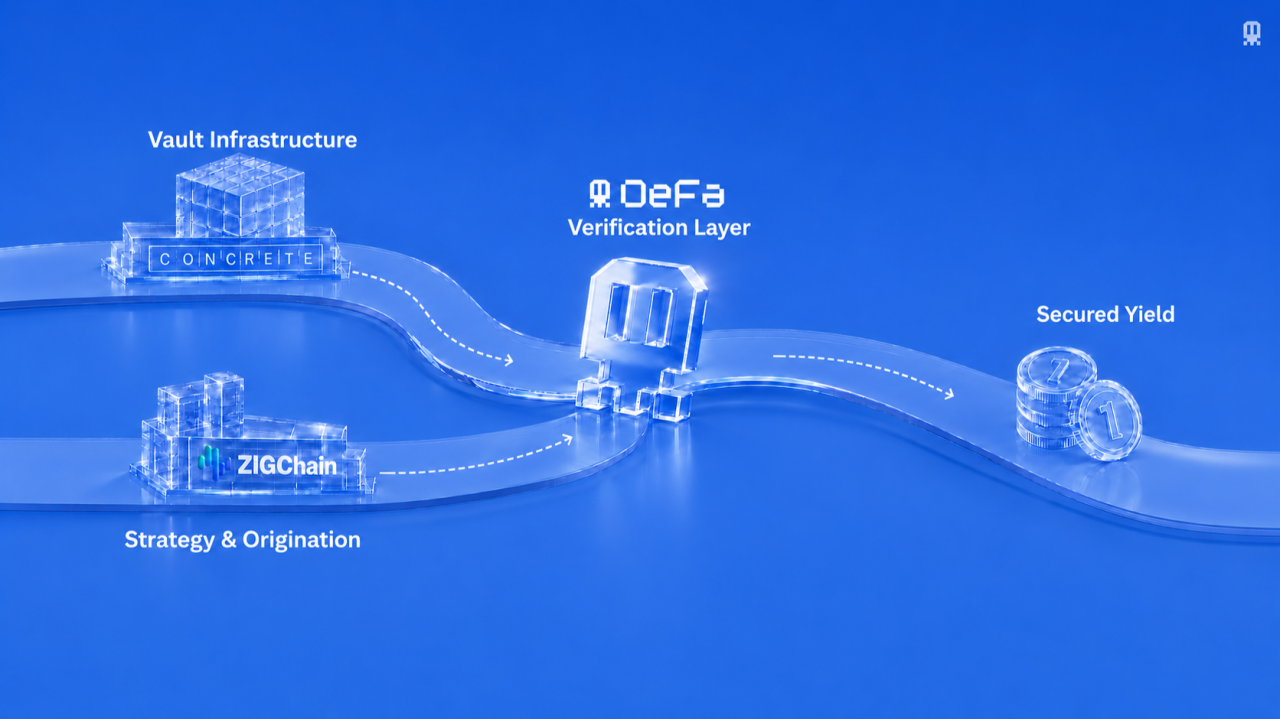
DeFa is the verification layer. Nothing draws from a facility until DeFa has cleared it.
That is not positioning. It is the operational reality of the structure. ZIG Markets by ZIGChain originates and manages the strategy. Concrete provides the vault infrastructure. DeFa sits between the capital and the counterparty, and every release of that capital is gated by DeFa. If the check does not pass, the transaction does not happen.
The reason the structure functions at all is that this layer exists. Short-duration receivables lending against real-world payment flows only holds together if someone validates each draw before it clears. That is the responsibility DeFa owns, for as long as the position is open.
How DeFa does it
Two things power the layer. Know Your Receivable, and DROOG.
KYR is the framework. Before a PSP draws against a facility, DeFa validates four things: the PSP itself, the counterparty on the other side of the transaction, the corridor the funds are moving through, and the underlying receivable that justifies the draw. Each of those carries documentation behind it. Regulatory licence, organogram, flow of funds, settlement volumes, corridor history, receivable proof. None of it moves without being matched and verified first.
DROOG is what makes KYR faster, deeper, and continuous. Every PSP comes with an extensive documentation set at onboarding, and every ongoing draw carries fresh receivable data that has to be cross-checked against that baseline. DROOG runs that verification alongside the risk team. It surfaces mismatches, flags gaps, and holds the audit trail behind every decision. KYR is the framework. DROOG is what runs it at the pace the model needs, cycle after cycle.
Why this is the part worth building on
Corridors will change. Stablecoins will change. The specific PSPs drawing on facilities today will not be the same set in two years. What does not change is the layer underneath. A stated capital requirement. A real-world business whose cash flow matches it. A verification discipline that runs every counterparty, every receivable, every cycle, for as long as the position is open.
That layer is DeFa. It is what makes short-duration real-world credit hold together. And it is what makes it worth building on.